

Ligonier Ministries recently partnered with LifeWay to conduct a survey in Canada to measure the state of theology among professing Christians. When the survey results were released, we sent the same survey questions to our congregation. What follows is a summary of the 35-question survey and how our church is similar, or is different than other Christians in Canada.
As one might expect from Christians in Canada, the results aren’t surprising yet are still disappointing. At the same time, I’m pleased with how our church answered. Some questions revealed a great gulf between the convictions of our family of faith and the broader evangelical world. In the end, it is not the counting of heads that settles the matter, but the word of God. We are reminded that it is the word that outlasts the planet even if God removes his lampstand from churches who were at one time faithful.
With that, let’s consider each question. For each question the survey will be summarized with a graphic showing how the original 3000 survey respondents answered. The “filtered respondents” are those who identify as evangelical and the “group respondents” are people who answered using the link we sent out in an email to Fairview Baptist Church mailing list.
Question #1
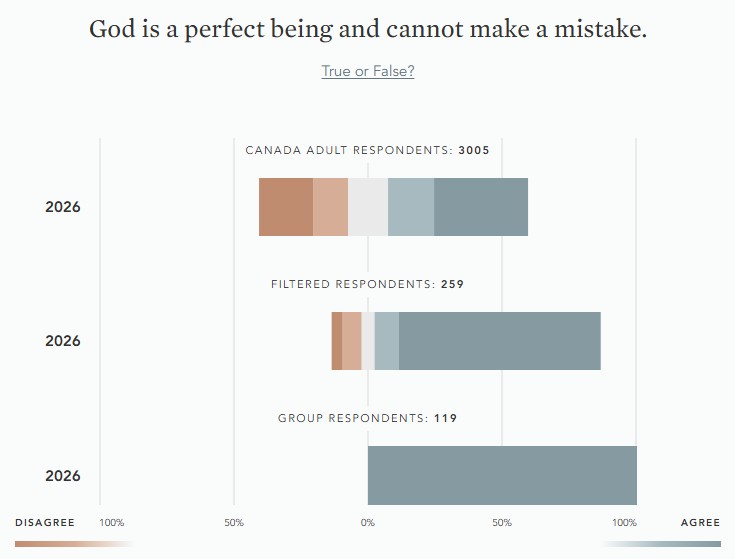
The Bible declares that God is perfect (Matt 5:48; Ps 18:30). His work is perfect (Deut 32:4), his way is perfect (Ps 18:30), his law is perfect (Ps 19:7), his gifts are perfect (Jas 1:17), and his will is perfect (Rom 12:2). Those who suggest otherwise must be judging God by their own standards.
Question #2
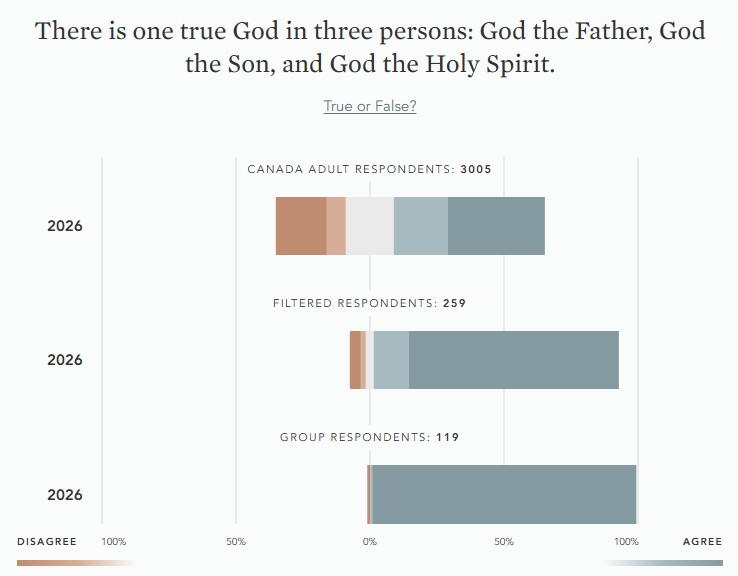
The Bible is clear, there is only one true and living God (Deut 6:4; John 17:3; 1 Tim 2:5). He is the Creator of all that is. This one God has revealed himself in three persons, Father, Son, and Spirit. The Father, Son, and Spirit share the divine nature, being co-equal, and co-eternal, distinguished only by personal properties. The Father is unbegotten, the Son eternally begotten, and the Spirit proceeding eternally from the Father and the Son (Gen 1:1-2; Ps 110:1; John 1:1, 18; 5:18; 16:7, 13-15; Acts 2:33; 5:3-4). See this sermon series on the Trinity for more details.
Question #3
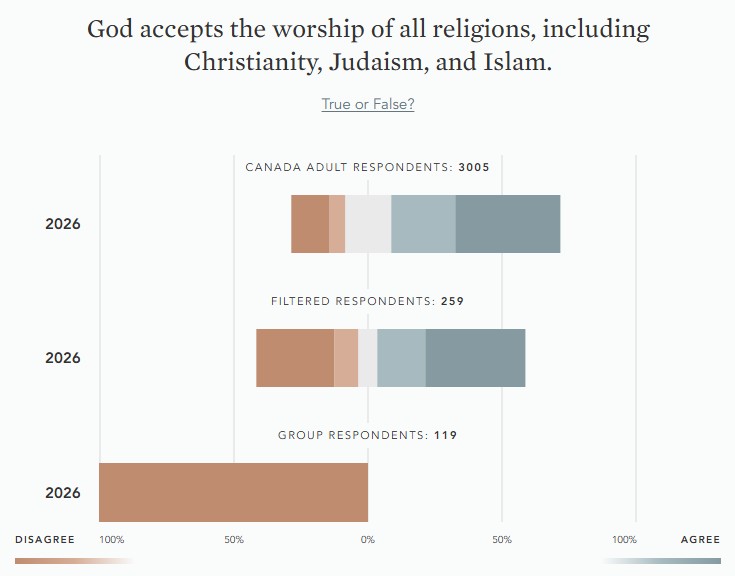
This question reveals an area of compromise and error in the Canadian church. God is clear that we are to have no other gods before him (Exod 20:3). Since Christ has come, all people everywhere must repent and come to God through Christ and Christ alone (Acts 17:29-31; John 14:6). There is only one mediator between God and men, Jesus Christ (1 Tim 2:5; Heb 7:25; John 4:24; 14:6). Therefore, God does not accept the worship of all religions, but accepts only those who come to him in spirit and truth through Christ.
Sadly, Christians in the West have bought into the lie of religious pluralism and that there are many ways to God. The exclusivity of Christianity is highly offensive, but it is true. The gods and “religions” of this world are the inventions of men who suppress the truth in unrighteousness (Rom 1:18-23). Only by entering the ark of Christ can one be saved from the coming flood of God’s judgment.
Question #4
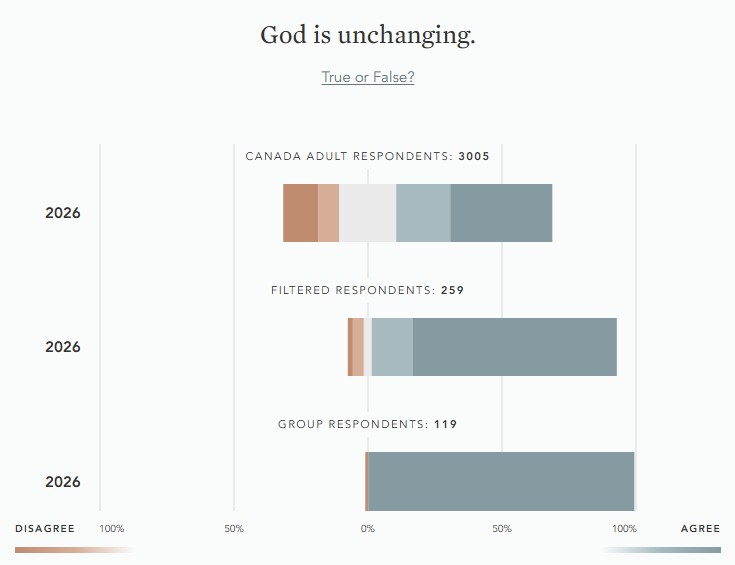
The Bible says that God does not change (Mal 3:6; Jas 1:17). God cannot grow, improve, or learn. He is perfect, lacking in nothing, and does not change. He does not adapt to his creation, changing his plans, but has established his will and purpose before the foundation of the world (Eph 1:4; Isa 46:10; Ps 33:11).
Question #5
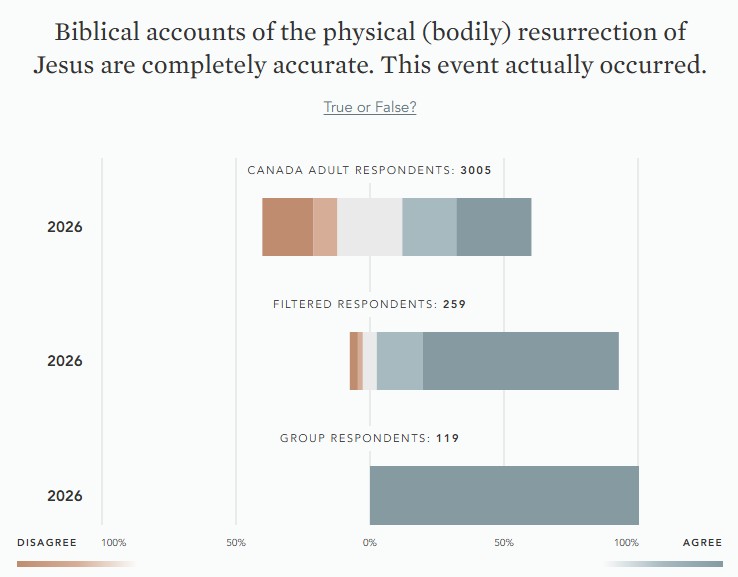
It might seem incredible that many people who profess to be Christians do not believe in the physical resurrection of Jesus. The Bible is clear, “If Christ has not been raised, then our preaching is in vain and your faith is in vain” (1 Cor 15:14). We are the most pitiable lot if Jesus has not been physically resurrected (1 Cor 15:19). The historical reality of Jesus’ resurrection is one of the central themes of the Scriptures. All the gospels agree (Matt 28:1-10; Mark 16:1-8; Luke 24:1-49; John 20:1-28). The Scriptures bore witness, the eye-witness testimony is overwhelming, and God himself bears witness (1 Cor 11:1-11; Matt 9:9; Luke 1:1-4; John 21:20-24; 1 Cor 15:12-28). One cannot deny the physical resurrection of Jesus and maintain an adherence to the Christian faith.
Question #6
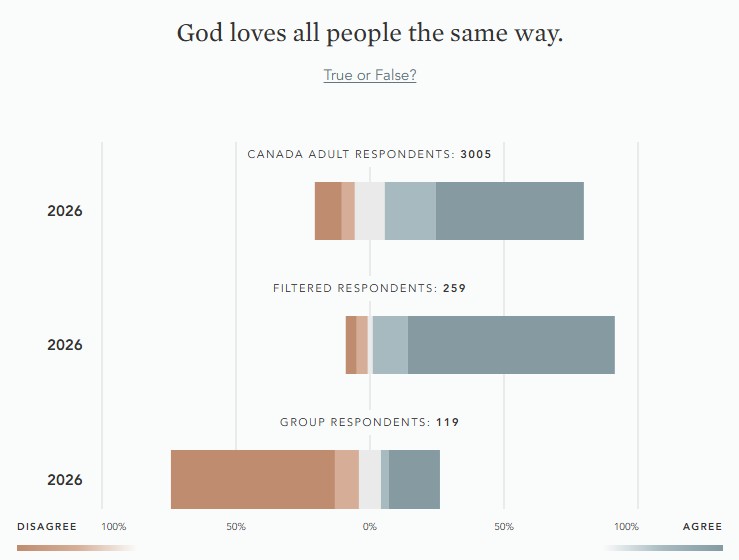
This question reveals a sharp contrast between our church and other evangelicals in Canada. Like the question above on religious pluralism, this question reveals that the contemporary church has bought the lie that God loves all people equally. The love of God is an unquestionable teaching in Scripture (1 John 4:8, 16). However, to say that God loves all people equally is to reject the beauty of his love.
It is true that God loves his enemies by sending rain and sunshine (Matt 5:44-45). Yet at the same time, God is rightfully angry with the wicked and he hates evildoers (Ps 5:5; 7:11; 11:5). He loved Jacob yet hated Esau (Rom 9:13). He loves his bride, the church (Eph 5:25; Rom 8:29-30) in an exclusive, covenantal way. This by no means diminishes God’s love, it magnifies it.
Consider a wife with a loving husband. If her husband loved all women the same way, you would conclude that he is not loving her at all! God’s love is universal to his creation, on account that he made all things, but the glory of his love is that it is particular to his elect, on account that he chose them, sent his Son to die and redeem them, and will keep and preserve them forever. This is love!
Question #7
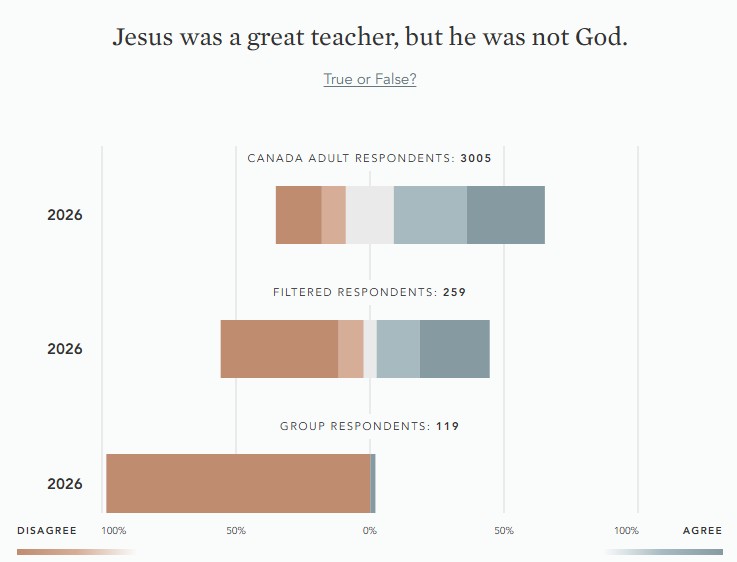
What an indictment upon the modern church in Canada where many professing Christians, and even many evangelical Christians, deny the deity of Christ. Scriptures testimony is plain. Jesus was a great teacher (Matt 7:28-29; Luke 2:47; 4:32) but he was and remains truly God (Luke 22:70; John 1:1; 10:30; Col 2:9; Rom 9:5; Titus 2:13). The spirit of antichrist is in the church today, “Every spirit that does not confess Jesus is not from God. This is the spirit of the antichrist, which you heard was coming and now is in the world already” (1 John 4:3).
Question #8
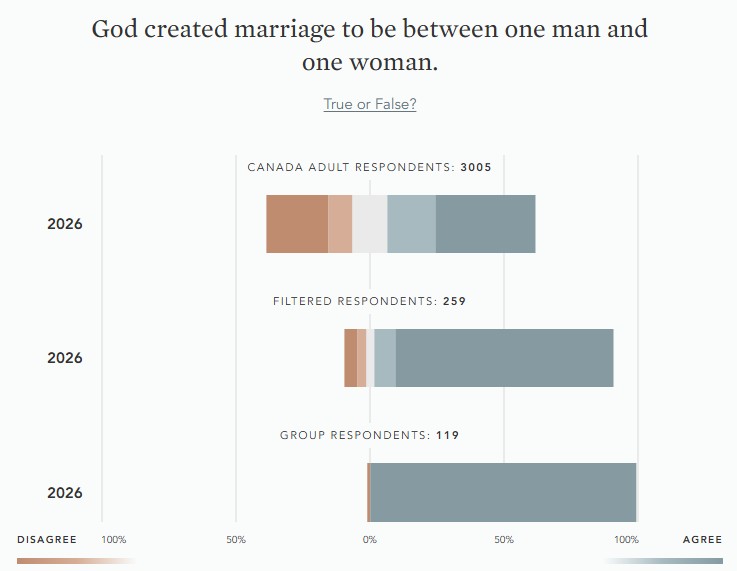
I was surprised to see that while so many evangelicals denied the Trinity, the deity of Christ, and the exclusivity of the gospel, that a majority still had a Christian conception of marriage. Of course, when the foundations are destroyed, it is only a matter of time before the whole building collapses. Yet, at least for now, many Christians still hold to a biblical view of marriage. We must remember that the God who created marriage remains the only one who can define it (Gen 2:24; Matt 19:4-6; Eph 5:31-32). Marriage is to be sanctified and held in honor among all (Heb 13:4). The attacks against marriage by the profane LGBTQ+ agenda, are evidence of the world’s hatred of God and will meet with God’s terrifying justice (Heb 13:4, 12:29).
Question #9
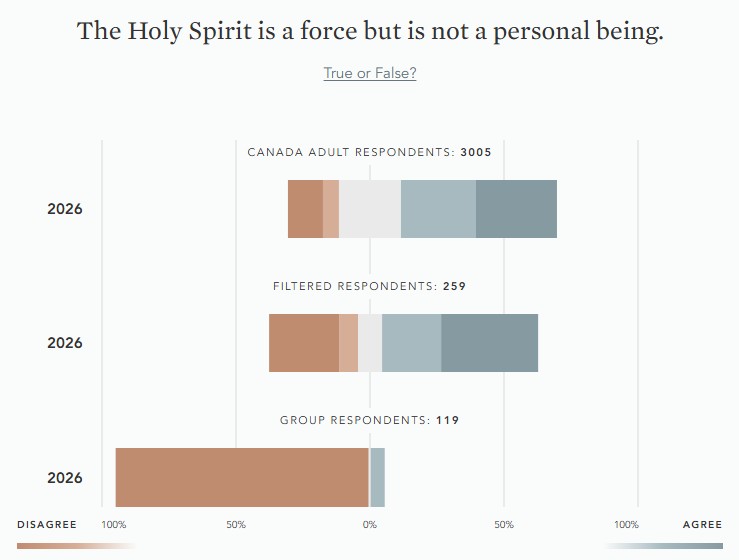
By the answers of modern evangelicals in Canada, the men (and women!) behind the pulpits are thereby indicted. God’s people are destroyed for lack of knowledge and it is the clergy that God holds to account for this (Hos 4:1-6). There is clearly very little to no teaching on the doctrine of God, the Trinity, the person of Christ, or the person of the Holy Spirit.
The Holy Spirit is a person who can be grieved or lied to (Isa 63:10; Acts 5:3; Eph 4:30). He speaks (Acts 13:2; Heb 3:7-11; 10:15-17; 2 Tim 3:16), he teaches (John 14:26), he leads and guides (Rom 8:14). He has a mind (1 Cor 2:11; Rom 8:27) and a will (1 Cor 12:11). He is one like Christ (John 14:16-17), a Helper of the same sort, the personal presence of God in the world.
P.S. Follow these links if you are looking for a sermon series on the Trinity or the Doctrine of God.
Question #10
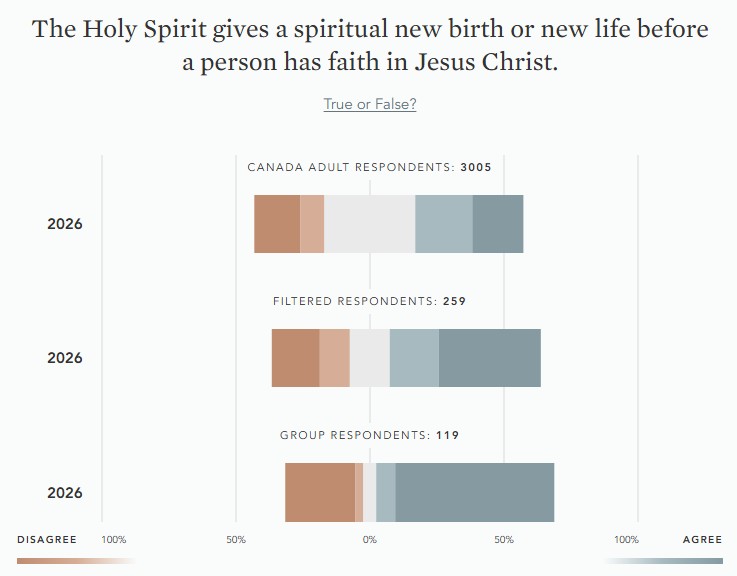
I would have expected most evangelicals in Canada to answer “false” to this question. It seems to me that the prevailing opinion in the church today is that we first choose Christ through faith and then God responds with the gift of his Spirit and eternal life. While my perception may be wrong on the modern church, there were still several people on the Fairview mailing list that answered this question as “false” when the Bible says that it is “true.”
Jesus taught that you must be born again before you can even see the kingdom of God, let alone enter it (John 3:3-5). The Spirit is required to open blind eyes (2 Cor 4:6) and give a new heart (Ezek 36:26) so that one would believe in Christ (1 John 5:1). Faith is a gift (Acts 11:18; Phil 1:29) that is granted not through human action, but God’s (John 1:12-13). Therefore, the Spirit must give new life before we can believe (Rom 8:1-11; Eph 2:1-10).
Question #11
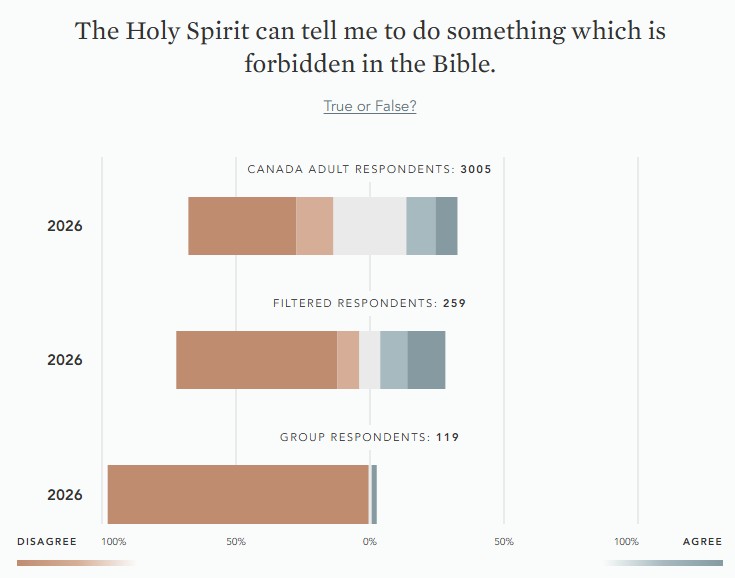
It appears that a minority of professing Christians believes that God’s revelation is not perfect but rather can be improved upon or even contradicted by God himself. The Scriptures are clear that all Scripture is authored by God through the Holy Spirit (2 Tim 3:16-17). As such, God does not contradict himself or correct himself. The law of the Lord is perfect (Psalm 19:7).
Question #12
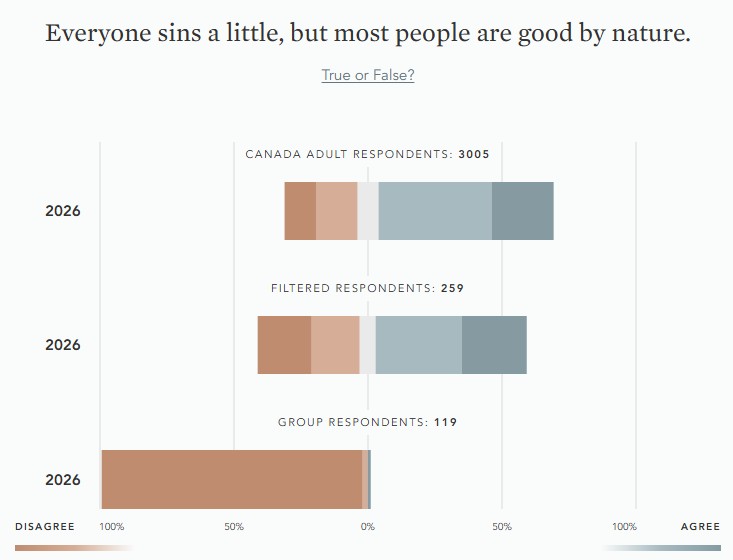
While most professing Christians and most evangelicals believe that most people are good by nature, the Scriptures clearly reveal that every human is born in sin (Rom 3:9-18). In our flesh, that is, our natural state, no one can obey God or live pleasing to God (Rom 8:7-8). We have inherited from Adam guilt and a sinful nature that is inclined toward wickedness (Rom 5:12ff). The intentions of our hearts are evil from our youth (Gen 6:5; 8:21). This doctrine of original sin or total depravity is certainly contrary to the spirit of the age which attributes innocence to humanity and blames outward forces for the corruptions of man’s heart. Jesus is surely right when he identifies the human heart as the source of the world’s corruptions (Mark 7:21-22). It is not that we sin and therefore become sinners; we are sinners and therefore we sin.
This doctrine, while rejected, is necessary to embrace not only because it is true, but because Jesus came for sinners and not for the righteous (Matt 9:13). Those who are well have no need of a physician and those who don’t believe they are sinful from the inside out have no need for the Savior. When we downplay sin, we minimize the Savior, mock God’s holiness, doubt God’s wrath, erase hell, and belittle grace .
Question #13
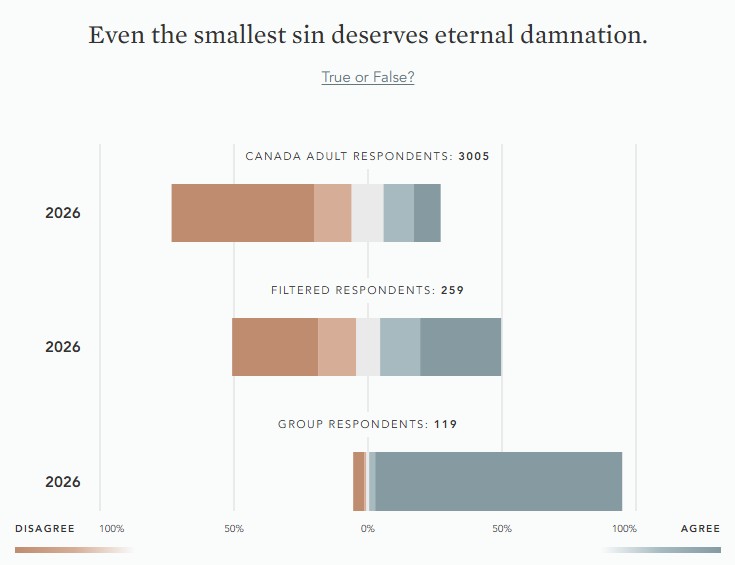
Consider the first sin that brought ruin and the curse upon the world and all humanity. While it may seem “minor” that our first parents ate the forbidden fruit, it was high handed rebellion against God. Sin against God is very great because of God’s perfection and holiness. In these answers where professing Christians answer out of step with Scripture, it reveals that they do not know God truly. His standard is perfection as he calls us to “be perfect as our heavenly Father is perfect” (Matt 5:48). When we fail to keep God’s holy law we become law breakers, are now guilty and under God’s curse (Gal 3:10-14; James 2:10).
While this may seem like terrible news with no possible way to be pleasing to God, Jesus Christ is our merciful, gracious, and necessary Savior who bears the curses of the law so that we might be reconciled to God in holiness. Just as one sin brings condemnation, Jesus’ one act of righteousness brings salvation.
Question #14
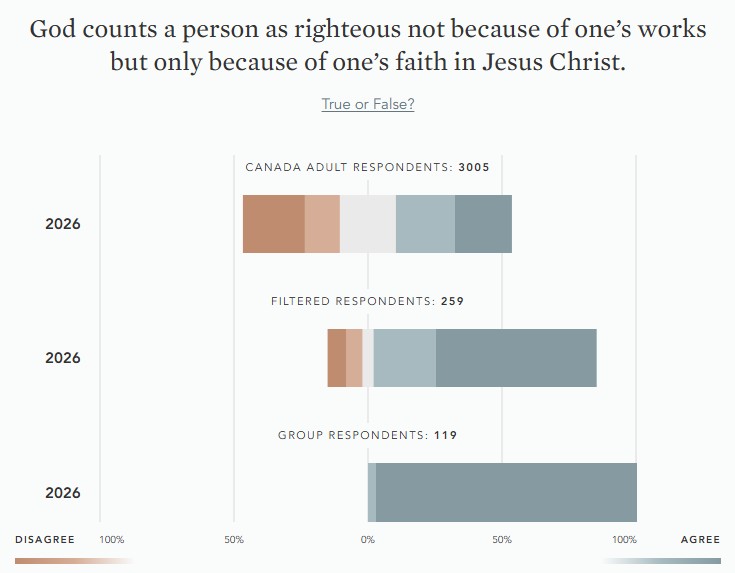
This statement is certainly true and captures the glory of the gospel. Titus 3:4-7 says, “But when the goodness and loving kindness of God our Savior appeared, he saved us, not because of works done by us in righteousness, but according to his own mercy, by the washing of regeneration and renewal of the Holy Spirit, whom he poured out on us richly through Jesus Christ our Savior, so that being justified by his grace we might become heirs according to the hope of eternal life (cf. Luke 18:9-14; Rom 4; Gal 3:1-9; Eph 2:8-9).
While we are justified by faith and faith alone, James reminds us that saving faith necessarily produces good works. Our works are not the instrument of our salvation but is the evidence of it (James 2:14-26). The survey results demonstrate that as people move away from a knowledge of the Scriptures, and therefore a knowledge of God, they move away from a knowledge of grace and how we are justified completely by our Lord Jesus Christ. The legalists are not those who follow the Bible too closely, they are those who follow the Bible too loosely.
Question #15
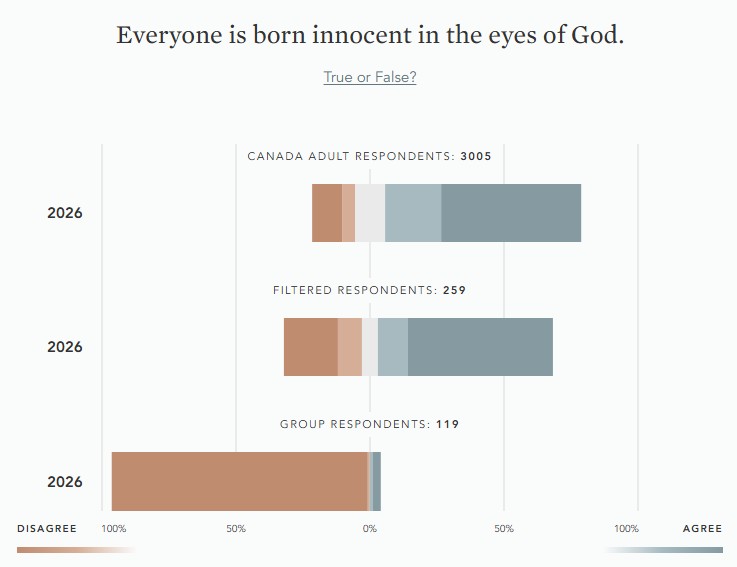
This statement, and result, is similar to question #12: “Everyone sins a little, but most people are good by nature.” The denial of the doctrine of original sin will lead to a denial of the gospel of grace. The argument of Romans 5 is that salvation of Christ by imputation or representation hinges on the fact that we are born guilty by imputation or representation. We are either in Adam (and therefore in sin) or in Christ (and therefore holy before God).
Question #16
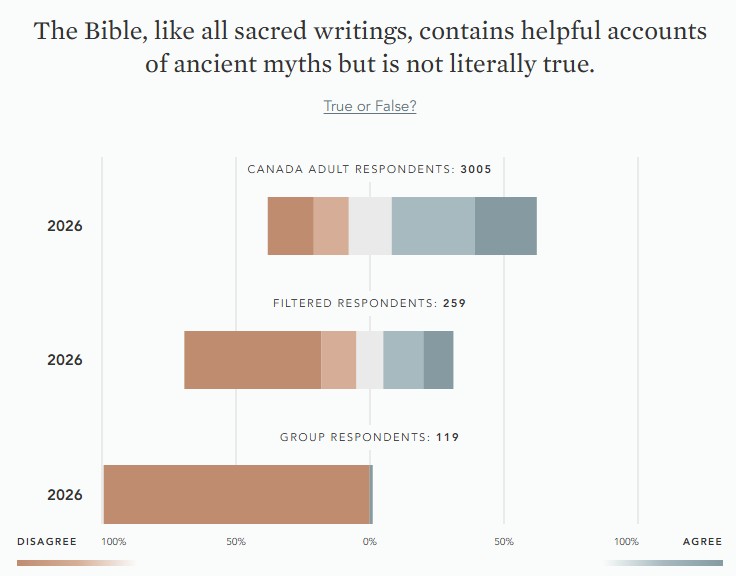
Sadly, most Canadians who profess to be Christians have little confidence in the word of God. One must ask the obvious question: if not the Bible, what are they following? In our religiously pluralistic culture it is tempting to put all religious texts on the same level along with all faiths. However, when speaking of truth, the Bible and other religious texts are incompatible. The Bible is more than helpful, it is true, reliable, and historically accurate. There are many historical events that are corroborated by outside evidence (2 Kings 25:1-21; 2 Chron 36:22-23). Jesus did not portray Adam, or Noah, or Moses as mythical figures but as real people in history. If the Bible is not historically true then Christianity is not true (1 Cor 15:14). Thanks be to God that it is historically true and therefore our confidence rests on a sure foundation.
Question #17
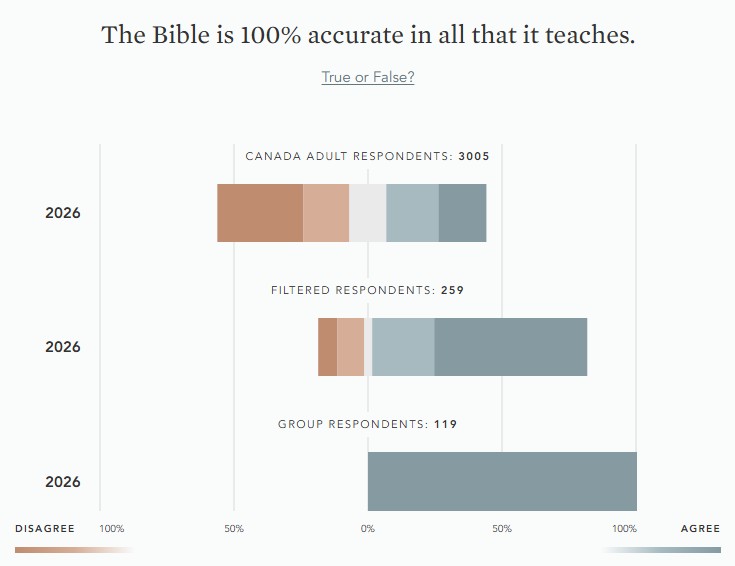
The Bible must be 100% accurate if we believe it authored by the God who does not lie (2 Tim 3:16-17; John 17:17; Psalm 119:160; Prov 30:5). For professing Christians who do not believe the Bible is 100% accurate, one must wonder which standard they use to evaluate Scripture. Modern liberal theology has made man the judge over God’s word. This process leaves the Scriptures rendering a picture of Jesus that uncannily resembles the modern liberal scholar! It is as if they have molded Jesus into their own image rather than being conformed to his. The Scriptures are the ultimate standard, being God’s own words. The Reformers had a slogan about the Bible: “norma normans non normata” (the norming norm that cannot be normed). In other words, the Bible is the norming norm that norms all other norms.
Question #18
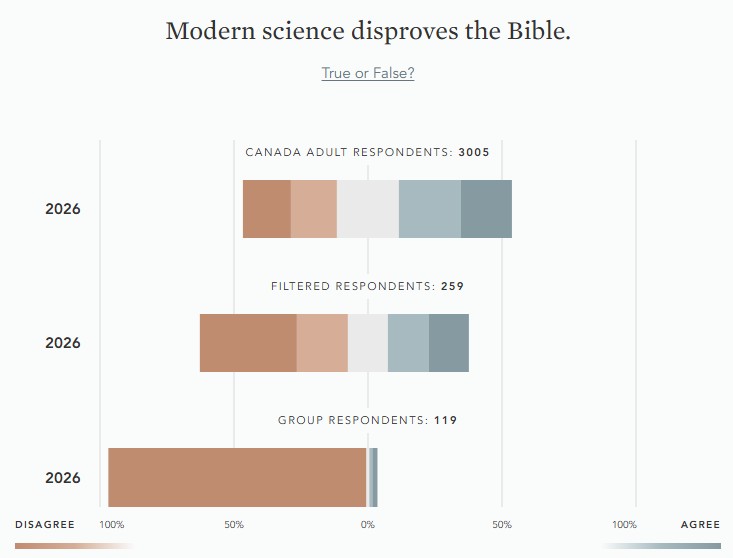
While it is obvious that the conclusions of modern scientists contradict the Bible (e.g., evolutionary origins), the study of the natural realm does not contradict the Bible. God reveals himself both in creation and in his word (Psalm 19; Rom 1:18-20; 2 Tim 3:16-17). Both the modern, secular scientist and the modern, Christian scientist have the same evidence. They draw differing conclusions, not on account of the evidence, but on account of their starting points. Today’s science excludes the possibility of God from the very outset. Science today seeks to understand our world from a purely naturalistic worldview. No wonder many do not see evidence for God, they ruled out that conclusion before they began!
Ministries like Answers in Genesis or Creation.com have aided the church today in demonstrating the harmony between the created order and God’s revelation in his word. Geological features that are appealed to to argue for deep time (like the Grand Canyon) make better sense in the biblical worldview and a global flood that drastically changed the landscape of the planet and brought to pass an ice age. Science and the Bible are not enemies but friends. They don’t need to be reconciled because there is no conflict. General revelation (science) and special revelation (scripture) are two “books” authored by the same God and are in perfect harmony.
Question #19
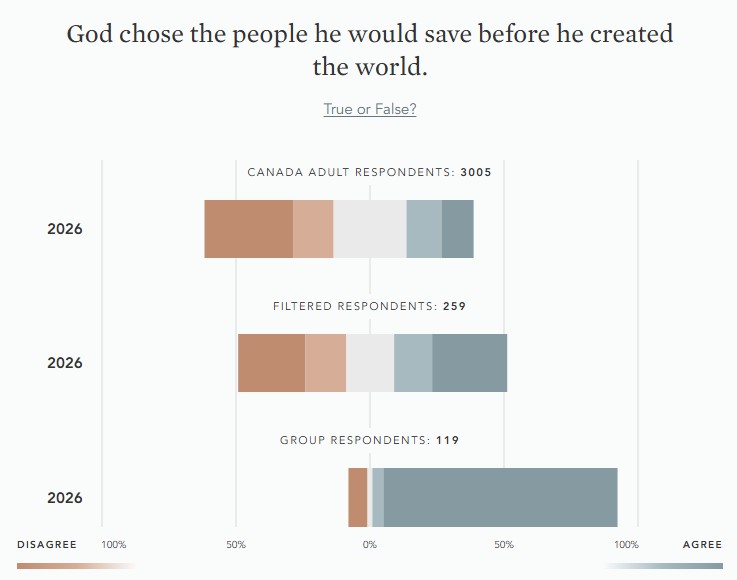
While the doctrine of election is controversial, it is clearly taught in Scripture (Eph 1:4-5, 11; Rom 8:29-30; 9:6-24; John 6:35-44). Rather than a stumbling block, this doctrine is a great comfort to the believer. Christian, you have been loved by God before the foundation of the world. When Christ our Savior died, he knew the ones for whom he died and in love he suffered in their stead. While this doctrine is typically denied to defend the free will of man, it ought to be embraced as true and as good.
Question #20
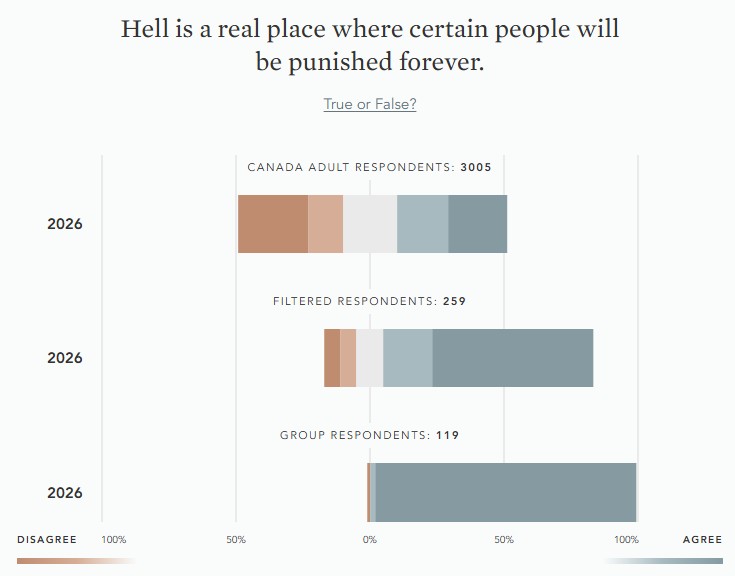
I was pleased to see that most evangelicals in Canada still believe in the reality of hell. Even if some the descriptions of hell are metaphorical (the undying worm of Isaiah 66:24), it is nevertheless taught to be a real place of conscience, eternal torment (Dan 12:2; Luke 16:19-31; 2 Pet 2:4; Jude 12-13; Rev 20:7-15; Matt 5:22-29; 10:28; Luke 12:5). While the idea of hell is a dreadful thought, it is a product of God’s justice and holiness. It is the fitting punishment for sin.
Some deny the “fairness” of hell by calling into question an eternity of punishment for finite sin. However, our sin is not finite, it is against the infinite God. Sin’s ugliness is not measured in human or temporary terms. Sin’s ugliness is measured by its offense to the infinite God who is holy, holy, holy. Besides, a person suffering in hell does not stop sinning. As the rich man in Luke 16 demonstrates, while there is a desire to ease the suffering, there is no repentance or turning to God. In fact, those in hell will grow from bad to worse. They will grow in their hatred, bitterness, and resentment toward God and all that is good.
Beyond the reality of hell, which cannot be denied biblically, it must be recognized that of all people, our Lord and Savior Jesus Christ spoke on hell the most. He did this from a place of love. He warns us to flee the wrath of God and find refuge in his wounds. May the horrors of hell not cause us to see hell as contrary to a loving God, but cause us to flee to a loving God for safety and salvation.
Question #21
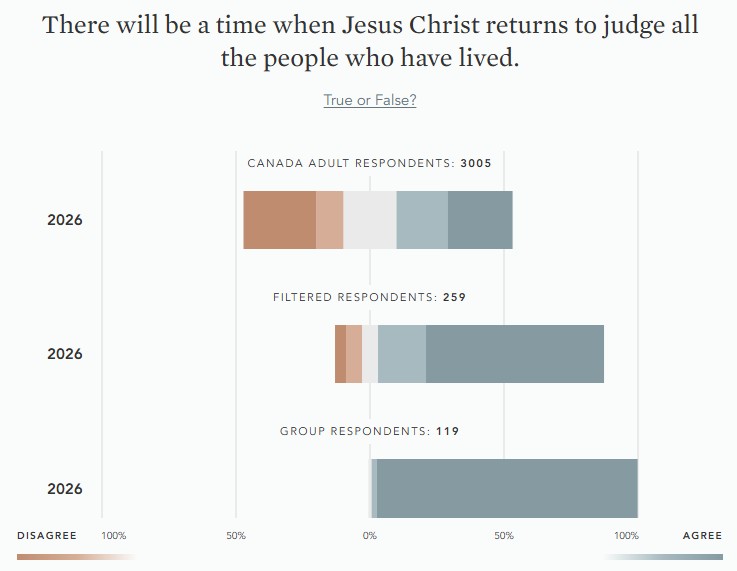
It seems incredible to me that most professing Christians surveyed are not sure about the return of Christ to judge the world. The return and judgment of Christ is sure (2 Tim 4:1; Rom 2:16), with the resurrection giving proof that it will take place (Acts 17:30-31). This is another indicator that the world has more influence over the Canadian church than the word.
Why is this truth so important? We are accountable to God. Accountability to God does not just matter for a future judgment but it matters how you live today. Knowing that each will give an account to Christ motivates us to live for him today (2 Cor 5:10). I have been accused of speaking too much about hell or the judgment of God at the end of this age, apparently we need more reminders of this, not less.
Question #22
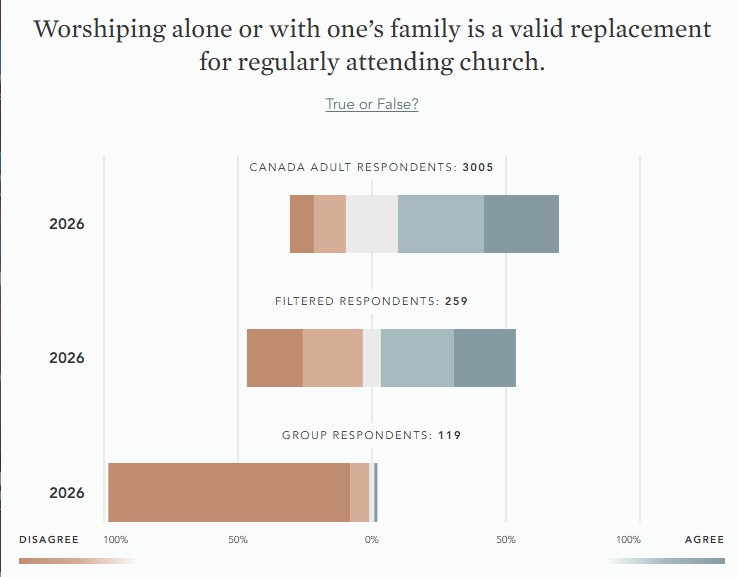
With the increasing individualization of our society (how many of your closest neighbors do you know well?), we put less emphasis on the corporate aspects of the Christian life. Gathering together as believers is essential and must not be neglected (Heb 10:24-25). This is not substitute or alternative. Christians must gather together for worship, teaching, fellowship, the sacraments, and prayer (Acts 2:42; 13:1-2; 20:7; 1 Cor 14:26). It is true that families should also be gathering daily around the word as the family is a mini-church. However, God has created the institution of the church with its leaders, preaching, and discipline to be the pillar and buttress of the truth (1 Tim 3:15). The church is not optional; it is essential.
Question #23
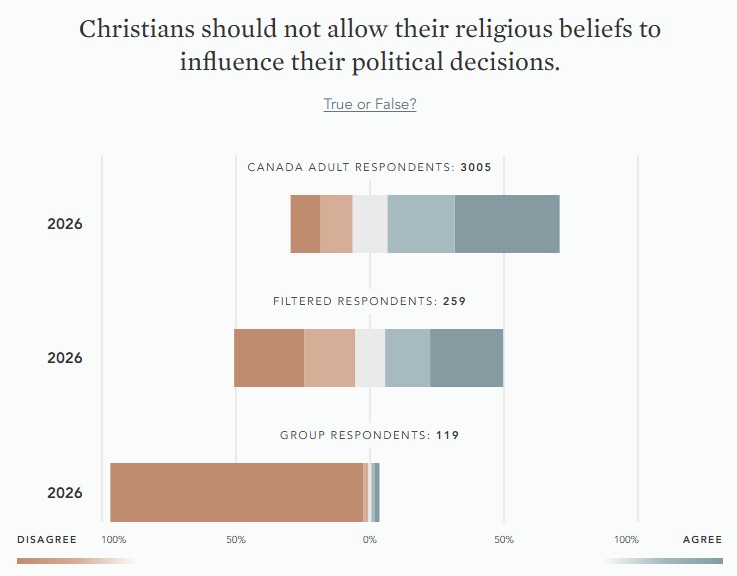
Here is an area where most Christians and non-Christians agree: Christians should keep their religious beliefs out of politics. What an indictment upon the modern church and what a slap in the face of our Savior who is called the King of kings and Lord of lords (Rev 17:14; 19:16). Revelation 1:5 states that Jesus Christ is (presently) the ruler of the kings on earth. Romans 13 teaches that the civil magistrate is a servant of God (literally deacon), an instrument of his justice (Romans 13:5).
Christians must bring the truth, clarity, and morality of Scripture to bear in all of life for the good of humanity as a whole. Christian principles lay at the foundation of western society and have made it the most prosperous place to live, ever. Limited government, freedom of speech, toleration, democracy, equality under the law, the rule of law, the list goes on. All of these emerge from a Christian worldview. Our individual lives, our homes, our churches, and our cities and nation should be governed by the principles of God’s word. This, and only this, will lead to good in this life and the one to come.
Question #24
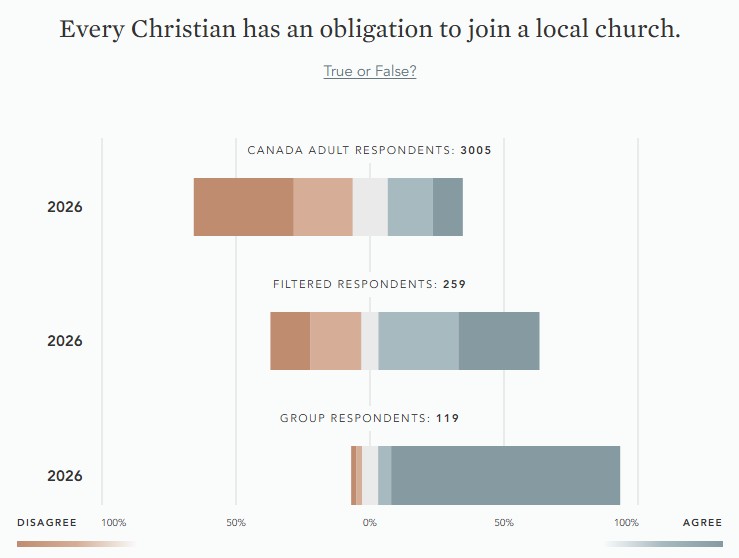
Like question 22 above reminds us, being meaningfully connected to a local church is an essential part of the Christian life. The Bible talks about us being members of the same body (1 Cor 12:12-27). We have gifts to share with one another (Rom 12:3-8). We have leaders to submit to and those leaders have congregants to care for (Heb 13:17). There is the necessity of discipline (Matt 18:15-17) and financial assistance to the poor and needy (1 Tim 5:9). In fact, there are many “one another” commands of Scripture that cannot be obeyed unless one is meaningfully part of a local church.
There was one time in the past when church membership was required to hold public office. In our individualist age church membership is uncommon. As Christians, we must return to the word, renew our minds, then reform our ways (Rom 12:1-2). In doing so, you will value the church and be an integral part of you local congregation.
Question #25
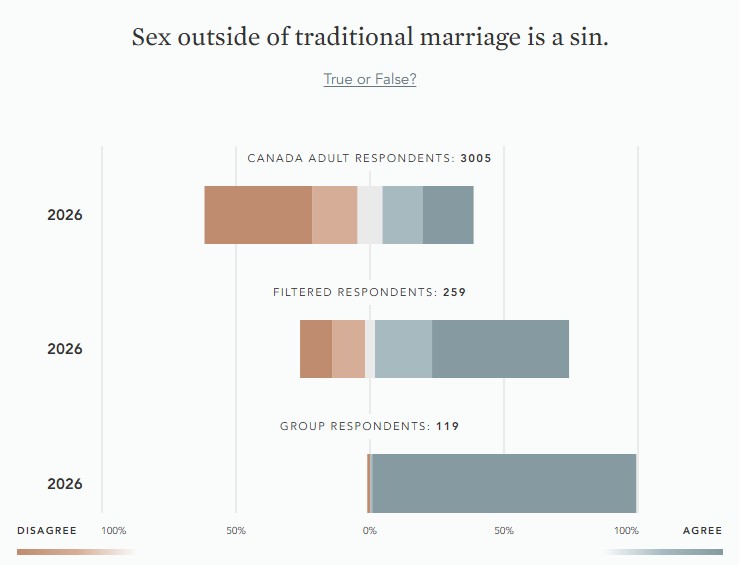
I was surprised by this result. I was not surprised that most professing Christians reject the Bible’s sexual ethic. I was surprised that most evangelical’s surveyed still believe it. Christianity has been attacked on several fronts. One of the battlefields where the enemy has gained ground is over sexual ethics. Unmarried couples living together used to be scandalous. Today it is commonplace. Sex before marriage used to be socially taboo, now its the norm. Satan’s devices do not just try to undermine truth, but undermine God’s morality and bring his corruption upon God’s good creation.
The Scriptures are clear that God’s design for sex is only within marriage between one man and one woman for life (Gen 2:18-25; Matt 19:3-9). All sexual activity outside of this sacred union is forbidden (Exod 20:14; 1 Cor 7). Sexual sin is especially heinous, offending God, and ruining the offender (1 Cor 6:12-20; Eph 5:3-5; Matt 5:27-30). Christians must not only been uncompromising on sexual sin, they must also be models to the world of the beauty of God’s design and the joy of faithful marriages. I’m thankful to be part of a local congregation where many families show the attractiveness of God’s design when its lived out faithfully.
Question #26
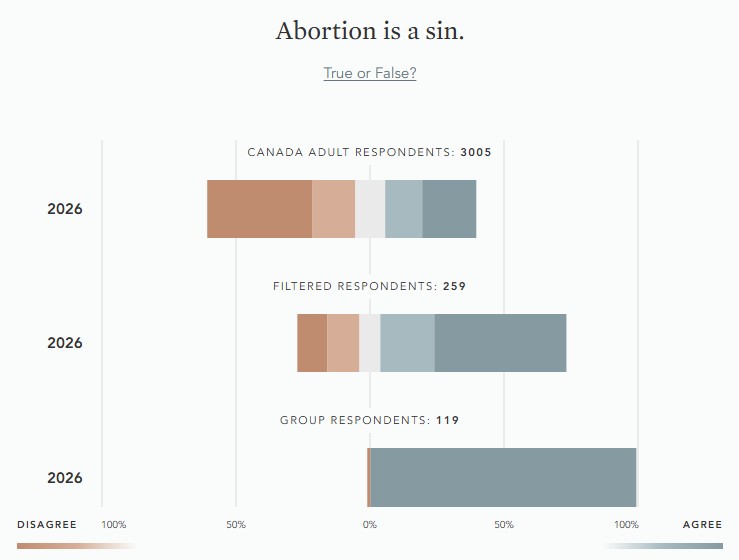
Yet another question which demonstrates that professing Christians are often indistinguishable from the world. Biblically, abortion is not just a sin, its a crime. Abortion is murder (Exod 21:22-25). Children, from conception, are made in the image of God and possess inherent dignity, value, and worth (Gen 1:27; Psalm 139:13-16; Luke 1:39-40). If someone takes the life of another person, then their life is required of them (Gen 9:5-6).
For more on this topic: https://www.fairviewbaptistchurch.ca/sermons/abortion-and-the-bible/ and https://www.fairviewbaptistchurch.ca/sermons/dont-murder-a-command-for-life-in-a-culture-of-death/
Question #27
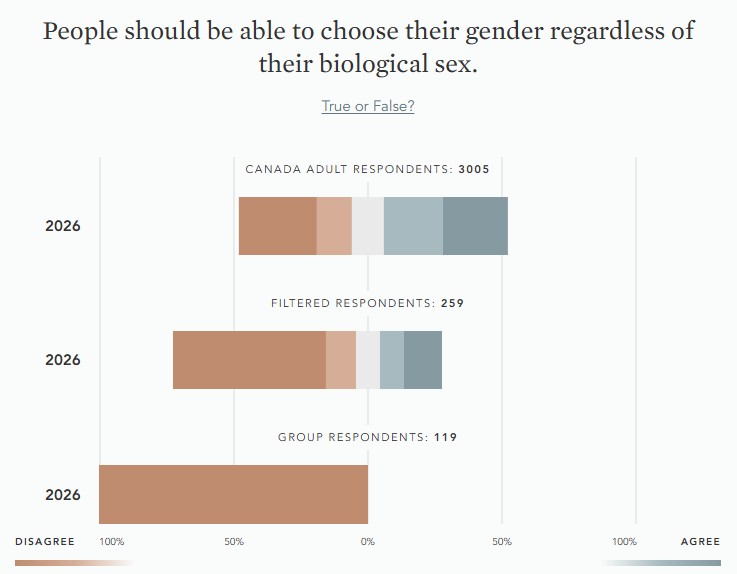
Gender is not something that any human being can choose. Gender is not “assigned at birth.” Gender is ordained by God (Gen 1:27). As creatures in rebellion to the Creator, we want to remove God’s mark or control over our lives and cast ourselves in our own image rather than God’s. But Christians should not only point out the folly of such rebellion, we should uphold the truthfulness and goodness of God’s design for men and women. In an egalitarian age, Christians must embrace the goodness of masculinity and femininity. God made boys and girls different yet good in their own right. Both men and women share in the grace of God (1 Peter 3:7) yet have unique giftings and callings in God’s world.
Question #28
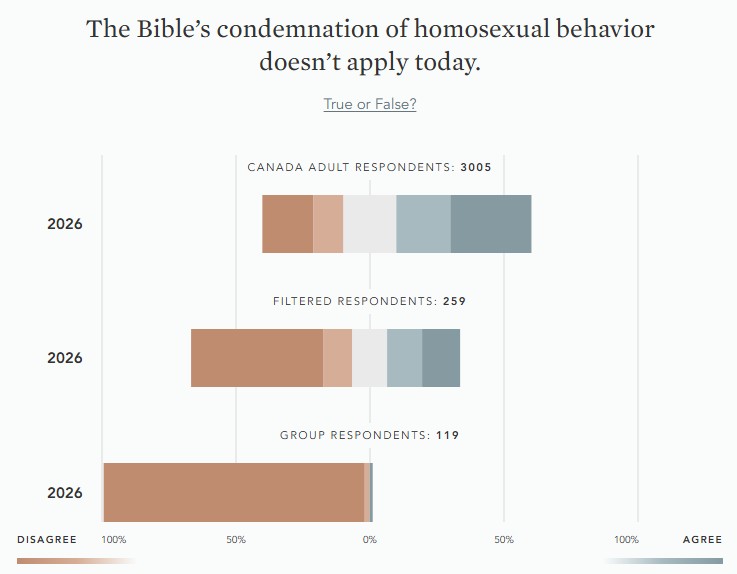
Homosexuality, not just the behavior, but the desire, is condemned in both old and new testaments (Lev 18:22; 20:13; Rom 1:18-32; 1 Cor 6:9-11; 1 Tim 1:10). The sexual ethic of a godless culture has won the minds and hearts of so many in the broader church.
Homosexuality is not only wrong and unnatural, it brings harm until an entire people and culture (Rom 1:18-32; 6:23). It is a great sin that requires repentance. Like all sin, there is forgiveness and hope for every sinner that comes to Christ, including deliverance from homosexual behavior and desire (1 Cor 6:9-11).
For more on this topic: https://www.fairviewbaptistchurch.ca/sermons/homosexuality-and-the-bible/ and https://www.fairviewbaptistchurch.ca/sermons/sins-destruction-the-root-and-fruit-of-lgbtq/
Question #29
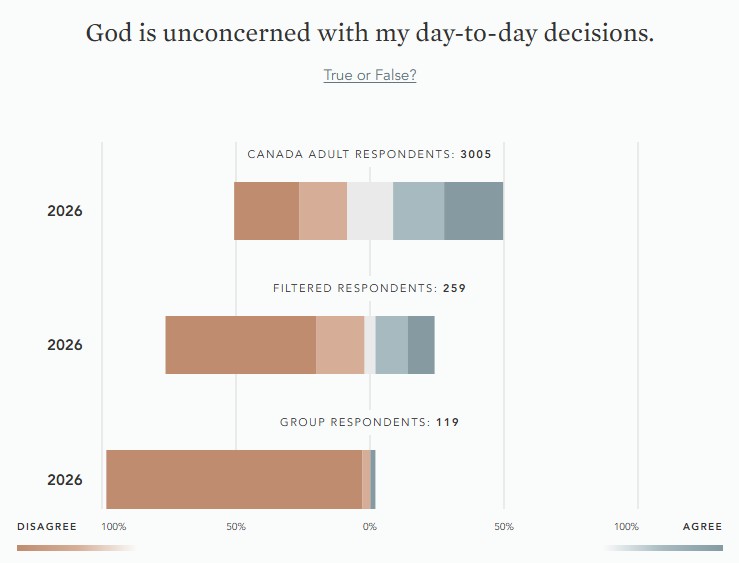
God governs all things (Psalm 33:13-15; Heb 4:13). As such, he cares very much about the day to day activities of his creatures, and especially of his people (Psalm 8:4; 1 Tim 4:10). God is concerned with what we wear (1 Tim 2:9), what we eat (1 Cor 8-10), how we work (Col 3:23), who we associate with (Titus 3:10), and every other decision that we make (1 Cor 10:31). God is both transcendent and immanent. He is above all and over all, yet near to us. All of life ought to be lived knowing that God sees and cares about all that we say, think, or do.
Question #30
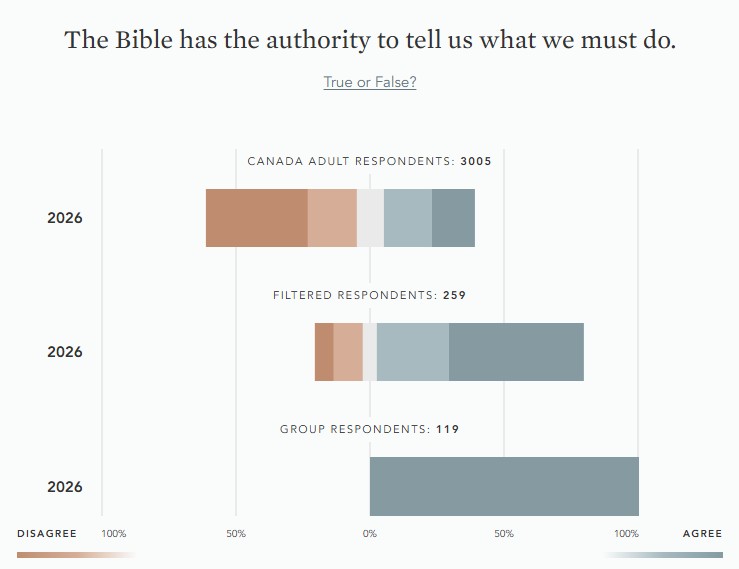
Isn’t it incredible that most professing Christians surveyed denied the Bible’s authority in telling them what to do? Jesus warned, “Not everyone who says to me, ‘Lord, Lord,’ will enter the kingdom of heaven, but the one who does the will of my Father who is in heaven” (Matt 7:21). There will be many who will be shut out of the kingdom of God because they did not submit themselves to God and his word.
Saving faith is not a mere intellectual assent to some facts concerning God or the Bible. Saving faith is trusting God and taking him at his word. Faith is not just believing in God, but believing God and doing what he says. God, as Creator, has authority to tell his creatures what to do. He has spoken to us through his word and we must conform our minds and actions to it.
Question #31
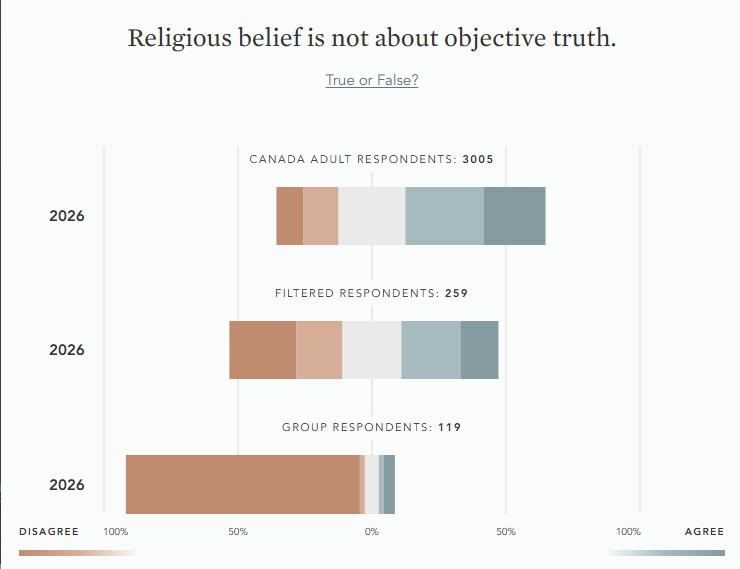
If religious belief is not about objective truth, then it must be that its truth is subjective. That is, rather than absolute and binding upon all, it is relative and personal, unique to each individual. Is this not the spirit of the age? To see that many evangelicals in Canada reject the absolute or objective truth of Scripture is astounding and discouraging at the same time. One wonders whether it is the world or the pulpits that account for this rejection of God’s truth.
Christianity is not personal nor subjective but based on the historical fact of Jesus’ death, burial, and resurrection (1 Cor 15:1-17). If this is not objectively and universally true, then Christianity is not true and we are of all people most to be pitied. There is no salvation unless their is absolute truth. Thanks be to God that Jesus is the way, the truth, and the life (John 14:6).
Question #32
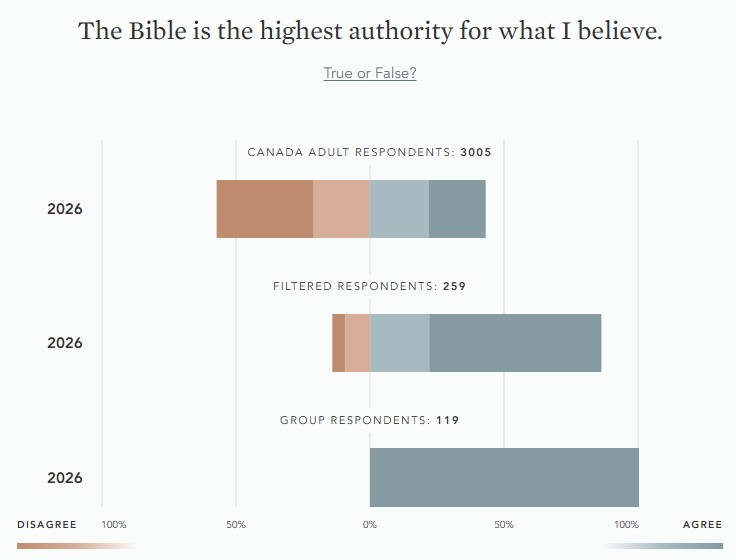
It is clear from the previous questions that the Bible does not take supreme place in the lives of professing Christians. It is apparent in this question that there is still some nostalgia concerning the Bible and its importance.
The Bible is the only source of God’s very words (2 Tim 3:16-17). That is, there is no where else we can read the words of God. As the words of God, what can be of higher authority? The authority of the Bible is an extension of the authority of God, for it the Bible, God speaks. Jesus said that all authority in heaven and on earth has been given to him and that we are commanded to teach his words and obey them (Matt 28:18-20). Therefore, there is no greater authority that we have then in Scripture (Matt 5:17-18; 15:1-9; Mark 14:43-49; John 10:35).
Question #33
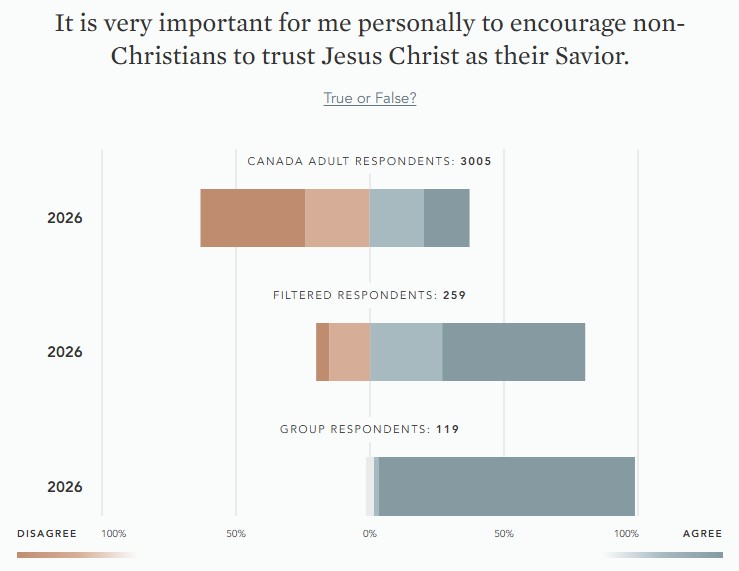
The world wants Christians to keep their faith quiet. Our society promotes multiculturalism (i.e., religious pluralism) where no religion (except secular humanism) should present itself as any more true or any better than others. But because Christianity is true, Jesus is the only way for any person to be reconciled to God (John 14:6; Rom 5:1). Therefore, it is necessary for Christians to be vocal and seek to persuade others of the truth of God’s word and what it says about Christ, forgiveness, and peace with God (Rom 10:9-17; Matt 28:18-20).
Question #34
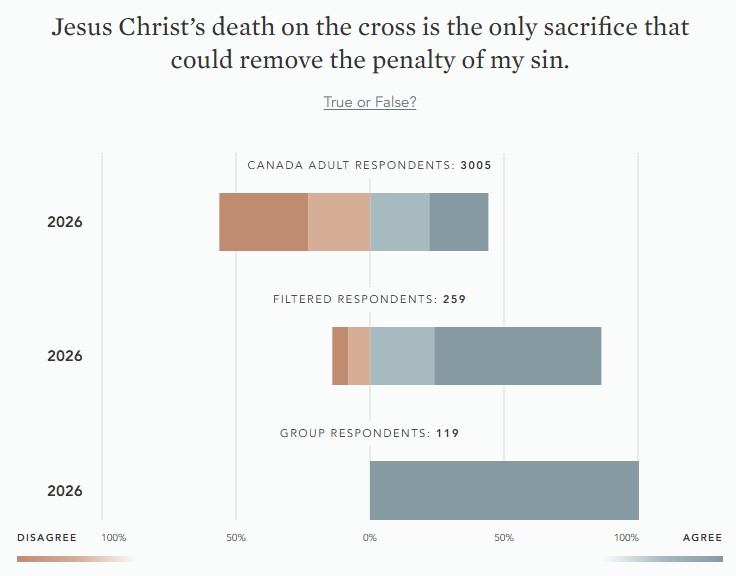
As we near the end of the survey, it has become apparent that many professing Christians in Canada are not Christians at all. They reject the trinity, the person of Christ, the authority of Scripture, the ministry of the Holy Spirit, and here, the efficacy of Jesus’ death. Jesus’ death, and only Jesus’ death, can save us from our sin and unite us with God (Isa 53; Rom 1:18-3:26; Heb 2:17; 10:1-18).
When sin entered the world, God promised a deliverer (Gen 3:15). The sacrifices of the Old Testament were a reminder that the wages of sin is death (Rom 6:23) but that God would allow a substitute, withholding his justice. In Christ, the Lamb of God, we have the once-for-all, perfect sacrifice where Jesus bears the penalty for our sin, satisfying perfect, divine justice, and presents us blameless before his heavenly Father. This is the very heart of the Christian faith. Without it, there is no salvation.
Question #35
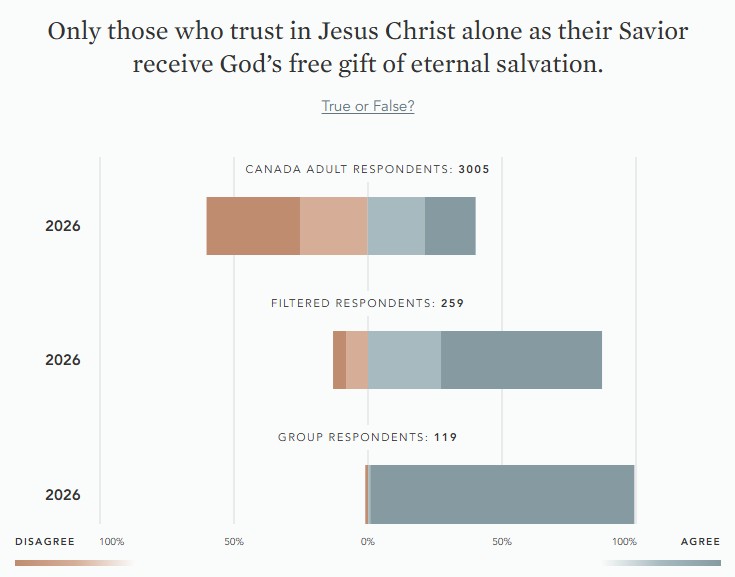
At this point, it should come as no surprise that many professing Christians are not Christians at all. Christianity is exclusive. Only those who trust Christ, the true Christ of Scripture, can be saved (John 14:6; Acts 4:12; Matt 16:24-25; Acts 16:25-34).
These survey questions have not measured deep or controversial doctrines. These survey questions have tested Canadians on clear, simple, and essential truths of the Christian faith. I’m thankful for how our church responded to the questions. I attribute this to the grace of God and to the fact that our church upholds the sufficiency, clarity, authority, necessity, and inerrancy of the Scriptures. Each week we consider the Scriptures in depth and submit ourselves to what we find continued therein. The exposition of the Scriptures is what will reform individuals, families, churches, and nations. The Canadian church needs more of the word of God. Pastors need to teach more of the word of God. Pray for the church and pray for the advancement of the word in Canada. Our future depends on it.
Pastor Tim Stephens