

I was out of town last week and unable to get my thoughts down on Alberta’s 2026 Referendum. Ten questions were posed to Albertans on a range of issues including immigration, election integrity, constitutional reform, and pursuing independence.[1] More than 2 million Albertans cast their votes as roughly 66% of eligible voters made their opinions known. The results are available at Elections Alberta, and every question was close, save the tenth question on Alberta independence. For that question, 75% voted to remain in Canada and 25% voted to begin the process of independence.
This is not the result I was hoping for. I’ve made my views clear that Alberta would be best served as an independent nation.[2] So what do I think of these results?
It may be surprising, but overall, I’m thankful. First, I’m thankful that we had the opportunity to have this important public conversation, brought awareness to important issues, and even had the chance to vote in a referendum. Second, I’m thankful that 25%—more than 500,000 people—voted for independence. One in four is a significant result when you take into consideration that every political party, all media outlets, and many powerful lobbyists were against independence and were in full campaign mode. On the other hand, there was no central representation for independence. It was truly a grassroots movement from start to finish. In fact, it has now become public that the Alberta Prosperity Project (APP) was in full crisis mode during the campaign with internal fractures and divisions. I made comments in February that some of the voices for independence would hurt the movement, and it seems those comments aged well. These same voices now seem intent on furthering a personal grudge against the Premier, Danielle Smith, and risk fracturing the conservative, UCP party. As the Lord said, a divided house cannot stand (Mark 3:25).
So after the dust has settled and considering the political forces that met in Alberta to do battle, it is significant that 25% still rejected the status quo and opted to strive for the difficult and risky work of forging a new country—or at least a new relationship with the federal government in Ottawa.
Learning Lessons
Before considering any lessons that can be learned from the referendum, I want to first analyze the available data and draw some conclusions.
The Data
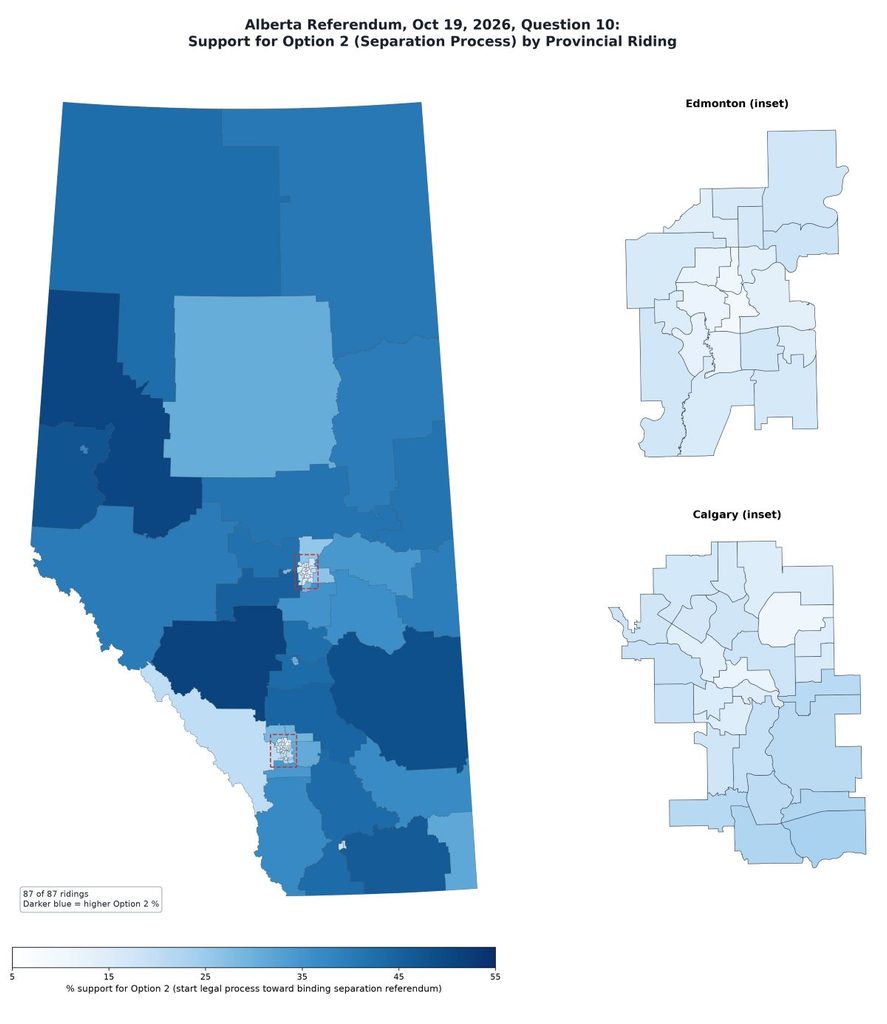
It is no surprise that support for independence was strongest in rural areas as compared to urban areas. In Edmonton, only 15% chose independence; 85% opted to remain. The numbers were similar in Calgary with 18% voting to pursue leaving Canada and 82% voting to remain. Mid-sized cities like Lethbridge, Red Deer, Medicine Hat, and so on voted nearly 30% in favor of leaving. In rural areas, on average, 39% voted for independence, with two ridings having a majority for independence.[3]
While the referendum results do not include voter age or gender, polls before and after the referendum give us a glimpse into how age and gender factor into the results. Polls demonstrated that men are more supportive of independence than women.[4] Polls also suggested that independence has higher support among voters under 65 with the strongest support to remain in Canada coming from those 65 years and older.[5]
Beyond age and gender, political alignment is also revealing. NDP and Liberal supporters were overwhelmingly for “remain.” UCP supporters were far more open to independence.
The Analysis
What are we to make of the data?
First, progressive voters are the most ardent advocates of remaining in Canada. This is hardly surprising since Canada is a hotbed of progressive, socialistic, neo-Marxist ideology. Our governments and institutions have been steaming ahead in that direction for decades under several Liberal governments from Trudeau Sr., Trudeau Jr., and now Mark Carney. Therefore, it should not be surprising when progressive voters in Alberta vote to remain in Canada—they agree with this secular humanist agenda. They want what Canada has become and is becoming.
It is only among conservatives that there remains any resistance to this new post-national, democratic-socialist vision of Canada. Yet, among conservatives, the majority want to preserve what good remains and work for reform within the current system. Nearly half, on the other hand, want reform but also believe reforms have been tried and failed, and so independence is the best path forward.
This divide among conservatives will be interesting to follow as Albertans head to a general election in a year’s time. It may be too early to say, but with independence support higher among younger voters, independence sentiments may increase and be the future of the conservative movement in Alberta. At the very least, with nearly half of conservatives supporting self-determination for Alberta, this issue is not going away.
Second, why does the older generation (65+) overwhelmingly reject notions of independence? While I cannot be definitive, my assessment is that the risk level is much too high. The 65+ demographic relies on the Canada Pension Plan (CPP) and socialized health care, and it has profited greatly from mass immigration forcing home prices to skyrocket. According to CREB historical averages, when this generation bought a house in Calgary in the 1970s–1990s, they paid around $70,000–$130,000. Today, those homes are valued at $800,000 or more! The policies of the older generation have enriched them and shut out the younger generation from the housing market altogether. It is no wonder that the older generation will ferociously defend the status quo while the younger generation is ready to risk instability for a better future.
Third, the strongest argument against independence was rooted in fear and risk. There are 10,000 unknowns when a province decides to leave Canada, and this uncertainty was leveraged to convince many it is better to remain, even if things are not good presently. I’m convinced this also explains why men are more supportive of independence than women. Men have higher risk tolerances, whereas women tend to avoid risk. In a society that is ruled by feminine norms, it seems unlikely that a majority would be willing to risk years of instability and uncertainty for the chance of building something better. It is my hope that a generation of young men will not be dissuaded from a vision for a brighter future and will have the willingness to risk and work and build something better for their households and the generations to come.
Fourth, the rural and urban divide will continue to factor heavily in the life of our province. Just as the larger populations of Ontario and Quebec hold the balance of power and rule the nation without meaningful representation from Alberta, so too will our provincial politics be settled by the people of Calgary and Edmonton, leaving rural and small-town Albertans without a voice in policies that affect their livelihoods and future. As cities continue to get bigger, this imbalance of representation will grow. Whereas the secular humanist vision sees centralized government as a blessing, the biblical vision is of local representation and more of a community or city-level governance (Exod. 18:21; Deut. 1:13–15). That is, those in rural Alberta wishing to come out from under the thumb of the federal government in Ottawa will also in time want to come out from under the thumb of a growing provincial government in Edmonton.
The Way Forward
The future of our province and country is uncertain. Those who voted to remain to keep stability may not get what they asked for. While the referendum is behind us and political leaders see the result as a clear judgment against independence, the underlying issues are still unresolved. A vote indeed took place, but the grievances which led to that vote have not been addressed.
With the other nine questions, which deal with grievances over immigration, an unfair constitution, and protecting provincial jurisdiction, roughly half of Albertans rejected the status quo. They understand that our relationship with Ottawa is problematic but still have fear over the risk and instability of independence, or they are unaware that constitutional reform is nearly impossible.[6]
People across our province need to be educated on the lessons of history. Michael Wagner’s latest talk at our church is a helpful summary and starting point.[7] Christians across our province also need to be educated on the lessons of Scripture, the goodness of liberty, the need for true justice and good government, and our responsibility to bring the Bible to bear on these important matters.
Independence will be part of the political conversation in Alberta, just like it is in Quebec, for a very long time. We should be informed and educated. While independence is a minority opinion, it is not a fringe minority that can be ignored.
As Christians, we must not lose heart. We work for the good of our city, province, and country, yet we do so knowing that our sovereign God is in control of all things. We don’t despair or get discouraged; we have received a a kingdom that cannot be shaken (Heb. 12:28). We must continue to be salt and light, pointing people to the goodness and wisdom of God’s word (Matt. 5:13–16). Above all, we must seek the conversion of our neighbors, and labor for the good of our homes, churches, communities, and cities (Jer. 29:7). We labor for the good of those around us as we bear witness to our King, Jesus Christ.
— Tim Stephens
Therefore let us be grateful for receiving a kingdom that cannot be shaken, and thus let us offer to God acceptable worship, with reverence and awe, for our God is a consuming fire.
Hebrews 12:28–29
[1] You can read the questions and my guidance for voters here: https://jeremiah29.org/article/voter-guide-for-2026-referendum/
[2] See the following articles: Alberta’s Future: Part 1, Alberta’s Future: Part 2, Why Alberta’s Independence Matters to the Church, Alberta at a Crossroads: Arguments for Independence.
Watch the following talks: A Christian View on Alberta First, For the Good of the City—Edmonton, For the Good of the City—Calgary.
[3] Rimbey-Rocky Mountain House-Sundre (51%) and Central Peace-Notley (50.4%). Other rural areas included results in the mid- to high 40s.
[4] Ipsos (mid-October): ~27% of men vs. ~19% of women. Mainstreet Research (Oct 15–16, which had an overall higher Option 2 share of ~34%): 41% of men vs. 28% of women.
[5] Mainstreet: 18–34: ~40%; 35–49: ~33%; 50–64: ~38%; 65+: ~23%. Research Co. and others generally showed stronger “remain” support among those 55+.
[6] Constitutional reform requires seven provinces with a majority decision, with senate changes requiring unanimity.